A well-established event
The Science Days take place every autumn at Europa-Park’s Confertainment Center in Rust, Germany, just across the Rhine from Alsace. The 2026 edition, the 26th, ran from 22 to 24 October, from 9 am to 4 pm. It is aimed at young people aged 10 and over, coming with their class or their family.
The organiser, Science & Technologie, is a non-profit company based in Teningen, recognised by the Baden-Württemberg Ministry of Education as an out-of-school research centre. In 2025, the event brought together more than 90 exhibitors and more than 11,300 participants. The 2026 figures had not yet been published at the time of writing.
Doing rather than watching
The principle never changes: young people do things themselves. Universities, schools and companies run workshops where you solder the components of a small circuit, set up a machine tool or a laser engraver, or take a seat in a racing simulator. Many workshops end with an object to take home, such as an electronic circuit that lights up.
The point is educational. Young people use technical devices every day without ever seeing inside them; holding a soldering iron or setting up a machine makes concrete what remains abstract in the classroom. The activities are in German, but many workshops can be understood with your hands.
A shortage of technicians on both sides of the Rhine
Behind the playful side, the event addresses a concern that Germany and France share: a lack of technicians and skilled workers.
In Germany, the German Economic Institute (IW) estimated in March 2026 that 133,900 skilled people were missing in science and technology occupations (MINT, the German equivalent of STEM):
- energy and electrical occupations are hit hardest, with 48,900 people missing;
- more than half of the gap (77,400) concerns skilled trades that require vocational training, not just engineering jobs.
In France, DARES (the statistics office of the Ministry of Labour) and France Travail, the public employment service, reach a similar conclusion in their study published on 22 October 2026. In 2025, half of all occupations were still under strong or very strong recruitment pressure, accounting for 46% of employment. Pressure remains very high in mechanics and metalworking, electrical and electronics, maintenance, and construction. The most affected occupations combine many hires with too few candidates, often because specific training is required.
In both countries these indicators are falling: the German gap shrank by 15.7% in a year, and recruitment pressure in France is at its lowest since 2017, excluding the pandemic. The decline is mainly due to slower hiring; the lack of trained candidates remains.
Industrial exhibitors therefore also showcase careers. The soldering kits carry the colours of SEW-EURODRIVE, a maker of electric drives and a partner of the event since 2025. On the EMIS stand, an electronic board shows what controls the lights, music and vibrating seats on board a roller-coaster train, based on the train’s position and speed. In 2025, Baden-Württemberg’s Minister of Justice, Marion Gentges, pointed out that a strong economic region depends on the inventors and thinkers of tomorrow.
Space as a common thread
Present for the first time in 2025, the European Space Agency (ESA) took a central place in 2026, in partnership with Europa-Park. Its programme announced a talk by German astronaut Alexander Gerst, a former commander of the International Space Station, and presentations by ESA managers on satellite operations, robotics, climate observation and artificial intelligence. On its stand: a quarter-scale model of the Hera probe, launched in 2024 towards a pair of asteroids, mini Mars rover demonstrations and virtual reality experiences.
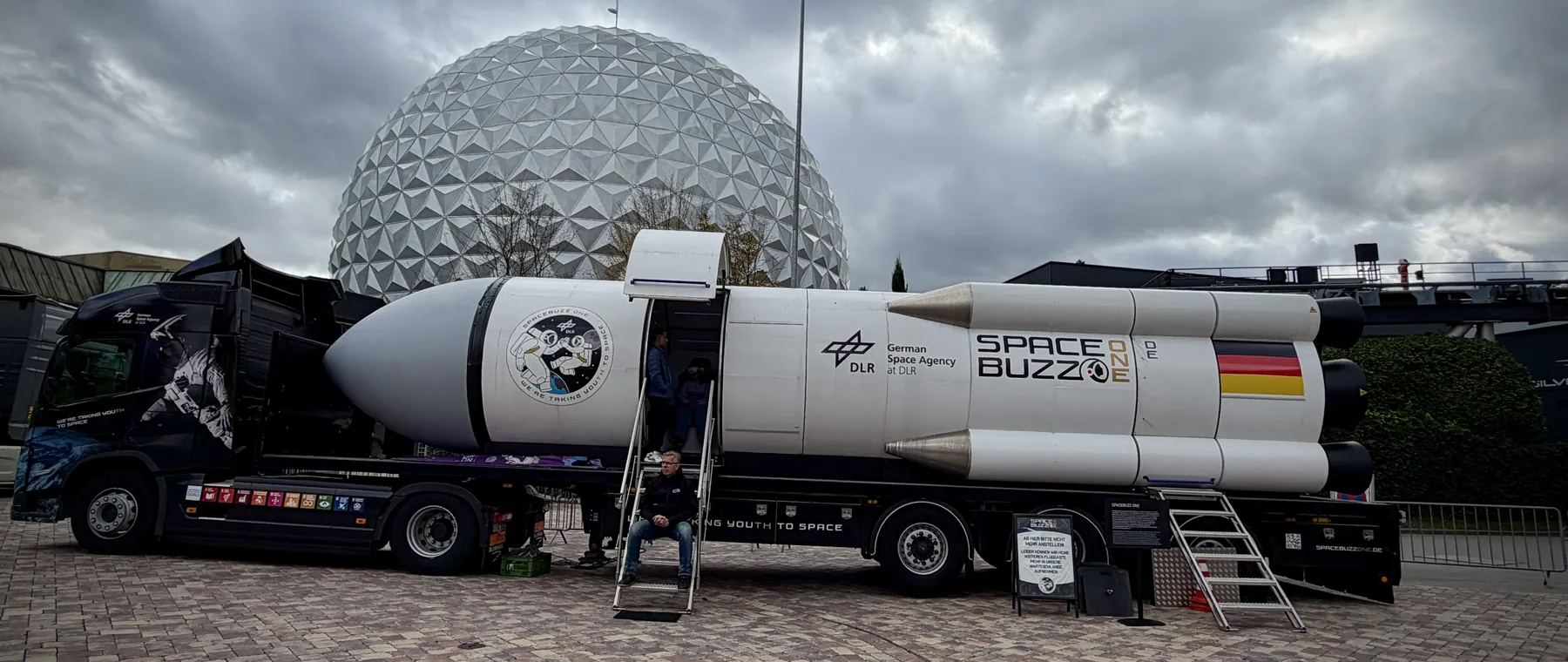
Outside the building, the Space Buzz One rocket truck of the German Space Agency at DLR offered a fifteen-minute virtual flight: moving seats, a VR headset, an orbit of the Earth, then a trip to the Moon and back, with a message about climate change.
This presence goes beyond the event itself. ESA speaks of a growing cooperation with Europa-Park, and in 2025 the park said it was in talks with the agency about a future space-themed area, with a family roller coaster by Mack Rides planned for 2028.
In France, the Fête de la science
In France, the Fête de la science, a national science festival, has played a similar role since 1991. Its 36th edition took place from 2 to 12 October 2026, on the theme “Saveurs savantes” (learned flavours), with thousands of free events.
The two formats complement each other more than they resemble each other. The Fête de la science is spread across science villages, laboratories and museums throughout France and puts research in the spotlight. The Science Days gather dozens of hands-on workshops in one place, with a strong presence of companies and careers. Both take place in October, about ten days apart: from either side of the Rhine, you can visit one and then the other.
The day in pictures
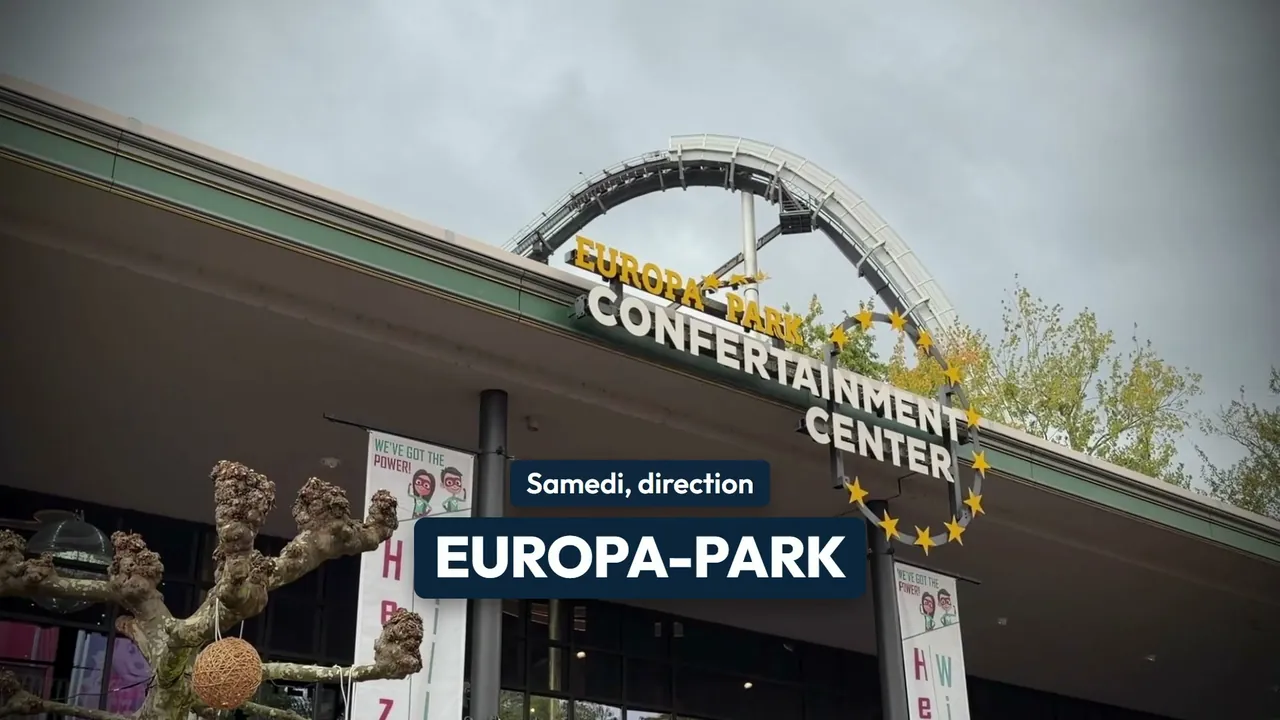
One minute of footage shot on Saturday 24 October: soldering and machining workshops, simulators, space stands.
 Play the video
Footage and editing: Les Techniciens du Net · Music: “Nowhere Land”, Kevin MacLeod (incompetech.com), licence CC BY 4.0.
Sources: Europa-Park, “Science Days” · Science & Technologie · EuroAmusement Professional, review of the 2025 edition · ESA, media invitation of 16 October 2026 · DLR, Space Buzz One · IW, MINT spring report 2026 · DARES, labour market tensions in 2025 (in French) · French Ministry of Education, Fête de la science · Accessed 25 October 2026.